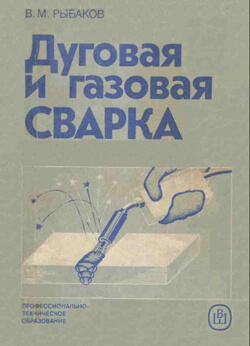
 Rybakov – Arc and gas welding
This textbook describes the design and operating procedures for equipment and apparatus for manual arc and gas welding and surfacing of metals, as well as for mechanized arc welding and oxygen cutting. It also provides information on welding and cutting technology for carbon and alloy steels, cast iron, and non-ferrous metals and their alloys. It also examines the types of welded joints and seams, potential defects, and methods for correcting them.
The second edition includes revisions reflecting new trends in the development of welding. The textbook can be used in the vocational training of workers in production.
In the context of scientific and technological progress, the development of those areas of science, engineering, and production that determine technological progress is particularly important. These areas include welding and cutting metals, which in many industries are among the main factors determining the pace of technological progress and have a significant impact on the efficiency of public production.
Welding and thermal cutting are widely used in the national economy.
The Soviet Union ranks among the world’s largest countries in the development of welding science and technology, and in some welding production indicators, it ranks first, such as the volume of welding work, the growth rate of welding consumables and equipment production, and the number of welders trained.
Enterprises are increasing their capacity for producing welded products, and surfacing is steadily expanding. Welded products are increasingly being produced not only from steel, but also from aluminum, copper, nickel, titanium, and their alloys, as well as from dissimilar materials, such as aluminum and steel.
One method for increasing the wear resistance of parts in mechanisms whose surfaces are subject to abrasion is surfacing with alloys with special properties.
Thermal cutting is a very common and progressive process for separating metal and its workpiece surfaces, in many cases completely replacing mechanical machining. Oxygen cutting is currently used for iron, titanium, and some other metal alloys. Along with oxygen cutting, low-temperature plasma cutting is also used. Gas laser cutting is crucial for scientific and technological progress, and its widespread adoption will yield significant economic benefits.
Both destructive and non-destructive testing methods, typically based on the latest scientific and technological advances, are used to monitor welding quality.
Only workers with a thorough knowledge of theory and best practices can produce excellent quality products, improve work practices, and adhere to the latest cutting-edge technologies. Improving the professional skills and cultural and technical knowledge of workers is of great importance.
Studying the theoretical foundations of welding combined with on-the-job training will enable students to become qualified welders.