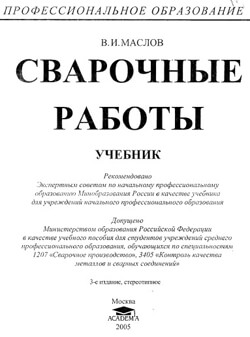
 Maslov – Welding works
The textbook’s content is based on curriculum materials on chemistry, physics, metal technology, and structural materials.
Maslov’s book “Welding Work” contains general information on welding, welded joints and seams, electric fusion welding, gas welding and cutting, and weld quality control. In addition to the main types of welding, their various variations are discussed.
The textbook “Maslov – Welding Work” is written in accordance with the State Educational Standard for the Welder profession and is intended for students of vocational educational institutions preparing workers for their chosen profession.
Modern technological progress in industry is inextricably linked with the improvement of welding production. Welding, as a highly productive process for producing permanent joints, is widely used in the manufacture of metallurgical, forging, chemical, and power equipment, various pipelines, agricultural and tractor engineering, and the production of building and other structures.
Welding is a technological process as essential as metal cutting, casting, forging, and stamping. It often competes with these processes, and in some cases, even displaces them.
Welding is one of the leading metalworking processes. Its significant advantages have ensured its widespread use in the national economy; without it, the production of ships, automobiles, aircraft, turbines, boilers, reactors, bridges, and other structures is now unthinkable. The prospects for welding, both scientifically and technically, are limitless. The use of welding contributes to the improvement of mechanical engineering and the development of new fields of technology, such as rocket science, nuclear energy, and electronics. The development of welding requires a significant increase in the level of theoretical knowledge and practical training of skilled workers.
The textbook material is based on information in chemistry, physics, metal and structural materials technology, electrical engineering, and other technical subjects. After completing theoretical and practical training and obtaining a qualification as a welder, one should continually expand their knowledge through self-study and further study at technical schools, industrial facilities, or universities. Highly qualified welders annually renew their qualifications in accordance with the requirements of the Federal Service for Environmental, Technological and Nuclear Supervision. This involves welding critical structures, such as pressure vessels and various pipelines.
The International Welding Association was established in Europe. It trains and supervises engineers, foremen, and welding workers every five years through a specialized program of theoretical and practical training, followed by certification and the issuance of an international certificate (passport) entitling them to perform critical welding work.
The International Institute of Welding (IIW) has been operating for over 30 years, periodically bringing together scientists working in welding theory and practice to discuss new advances in science and technology, exchange information, and pool efforts to address complex scientific and technical challenges.
Based on the recommendations of the International Institute of Welding, a uniform classification of the main types and grades of welded joints has been adopted worldwide, with the exception of some differences in the requirements of individual GOST standards of IWI member countries.
The textbook consists of four independent parts: Part One—General Information on Welding, Welded Joints, and Seams; Part Two—Electric Fusion Welding; Part Three—Gas Welding and Cutting; and Part Four—Weld Quality Control. In addition to the main types of welding, the textbook also covers their various variations.