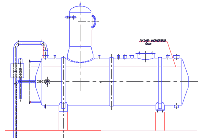
SHELL AND TUBE HEAT EXCHANGERS
Shell and tube heat exchangers differ from sectional heat exchangers in that they contain a larger number of tubes in the tube bundle, typically ranging from hundreds to thousands. Because of this, shell and tube heat exchangers are more compact than sectional heat exchangers, meaning they accommodate a larger heat transfer surface per unit volume. Furthermore, the design of shell and tube heat exchangers allows for various heat transfer patterns.
Shell and tube heat exchangers can be used for any combination of heat transfer fluids: liquid-to-liquid, gas-to-liquid, or gas-to-gas. All shell and tube heat exchangers share the same characteristics: a large number of tubes (a tube bundle), the ends of which are hermetically sealed in holes in tube sheets (grids), and a common shell enclosing the tube bundle from the outside. Industrial shell and tube heat exchangers typically use tubes with an internal diameter of at least 12 mm and no more than 38 mm. The lower limit is determined by the ease of cleaning the inner tube surface, while the upper limit is determined by the reduction in the specific surface area of the heat exchanger.
The possible tube bundle length is typically 0.9 to 6 m, with a tube wall thickness of 0.5 to 2.5 mm. Tubes with a diameter of less than 12 mm are used in cases where there is no risk of fouling their inner surface and when it is necessary to increase the compactness of the heat exchanger.
Heat transfer fluids that can foul the heat transfer surface are directed into the cavities of the tube bundle, as only these cavities are accessible for mechanical cleaning.
Shell-and-tube heat exchangers achieve relatively large ratios of heat transfer surface area to volume and mass. The heat transfer surface dimensions can be easily varied over a wide range.
Tubes are the primary element that ensures heat transfer between the coolant flowing inside the tubes and in the annular space. Tubes can be either smooth or have low fins on the outside. In the latter case, the fin outside diameter is selected slightly smaller than the outside diameter of the unfinned tube ends, allowing the finned tubes to be inserted through the holes in the tubesheet.
The tubes are secured in the tubesheets at each end (except for U-shaped tubes, which are secured in only one tubesheet). The tubes are either flared into the tubesheet or welded to them externally.
The tubesheet is a metal disk with holes for the tubes and sealing elements.
The jacket is a cylinder containing the tubes and circulating coolant. It is typically manufactured by rolling a metal sheet of the appropriate size and welding it with a longitudinal seam. Small-diameter jackets (up to 0.6 m) can be made from pipe cut to the desired length.
The coolant enters the jacket through the inlet nozzle and is removed through the outlet nozzle. Most often, nozzles are made from standard pipes that are welded to the jacket. In cases where a two-phase flow or saturated steam is introduced into the annulus, deflector plates slightly larger than the cross-section of the inlet nozzle can be installed inside the casing behind the inlet nozzle. This protects the area of the tube bundle where the inlet steam flows from abrasive wear.