A key element of most shell-and-tube heat exchangers is the set of transverse baffles in the intertube space. These increase the velocity of the coolant flowing between the tubes and also protect the tubes from bending and vibration. Furthermore, the baffles direct the coolant flow across the tubes, improving heat transfer but increasing hydraulic pressure losses.
Segmental baffles are the simplest design option. They are shaped like a circular segment with openings for the tubes of the tube bundle. The main requirements for baffles are that all tubes are uniformly supported and that subsequent baffles partially overlap at least one full row of tubes to ensure sufficient tube bundle rigidity.
Below, as an example, an analysis of the design of a modern type of shell-and-tube heat exchanger is provided.
Small-sized, dismountable water-to-water network water heaters, type PVMR
They are designed for industrial boiler houses and heating units, and can also be used in other types of heat power equipment in various industries.
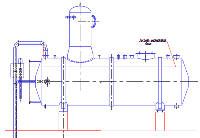
The design of the PVMR type heaters, which have two passes for heated network water, is shown in Figure 1.4, while Figure 1.5 shows the flow diagram of the coolant in this unit. It can be seen that the heat exchanger has two passes for the coolant moving in the tubes. Furthermore, Figure 1.5 shows five passes for the coolant moving in the intertube space. Accordingly, four segmented baffles (7) are depicted.

Figure 1.4. Schematic diagram of the PVMR heater: 1 – distribution chamber; 2 – casing; 3 – pipe system; 4 – small water chamber; 5 – removable
casing part; A – network water outlet; B – network water inlet; C – heating water inlet; D – heating water outlet.
Changing the number of segmented baffles changes the number of passes the coolant makes in the intertube space. The heat exchanger operates as follows. Heated water enters distribution chamber 1, equipped with baffle 8, through pipe B and is directed into the tube cavities of the lower (as shown in the figure) half of the tube bundle. Then, after passing through water chamber 4, the heated fluid returns through the upper half of the tube bundle to chamber 1 and exits through pipe A. The heating water enters the heat exchanger body through pipe B and, after making 5 passes between segmented baffles 7, exits through pipe G.

Figure 1.5. Schematic diagram of coolant flow in the PVMR heater. Designations are the same as in Fig. 1.4. In addition: 6 — tube sheet; 7
— segmental baffle; 8 — distribution chamber baffle.